Sicily: Difference between revisions
No edit summary |
|||
| (23 intermediate revisions by 2 users not shown) | |||
| Line 29: | Line 29: | ||
== Travelling to Sicily == | == Travelling to Sicily == | ||
You don't have to book the short boat journey from Italy to Sicily, so we can wing it, basically. Trips to Messina depart from Villa San Giovanni every 20 minutes and it takes 40 minutes to get there. I'm hoping we leave the [[Central|place near Naples]] quite early in the day to travel to Sicily. The journey on land will take quite a long time from there to Taormina, so it's unlikely we'll be able to do much on the Friday night, but we could always go to a couple of bars around Taormina. | |||
== Etna == | |||
==== Background ==== | |||
On our first full day in Sicily, we'll attempt to go up Mount Etna. Mount Etna (or Aetna, also known locally as Mongibello) is an active volcano on the east coast of Sicily (Italian Sicilia), close to Messina and Catania. It is the largest volcano in Europe, standing about 3,320 m (10,900 ft) high with a basal circumference of 140 km, making it the highest mountain in Italy south of the Alps. Etna covers an area of 460 square miles (1190 km²). It is by far the largest of the four active volcanos in Italy, being nearly three times the height of the next largest, Mount Vesuvius. It is one of the most active volcanoes in the world and is in an almost constant state of eruption. Although it can occasionally be very destructive, it is not generally regarded as being particularly dangerous. | |||
See this [http://en.wikipedia.org/wiki/Etna Wikipedia article] for information on Mount Etna. | |||
==== Stuff we'll do ==== | |||
Er, go up Etna. We should get up early on Saturday and go up Etna for the majority of the day. It's difficult to find out, from the web, how to get up Etna, so I think it's best to just ask around when we're nearby. Should we finish our trip around Etna before the end of the day, we can visit Taormina for the afternoon and evening. | |||
[[Image:tick.gif]] Route up and down Etna decided (sort of - we'll just find out when we get there) | |||
== Taormina == | == Taormina == | ||
| Line 39: | Line 53: | ||
Taormina is in the Province of Messina, together with the beautiful Aeolian Islands and the ancient city of Milazzo. It can be reached via highways [autostradas] from Messina to the North and Catania to the South. Taormina has been a very popular destination with tourists since the 19th century. It has beautiful beaches (accessible via a Funicular) by the Ionian sea, which is remarkably warm and has a high salt content. Isola Bella is a stunning natural reserve that is just south of Taormina. Tours of the Capo Sant' Andrea grottos are also available. Taormina is built on an extremely hilly coast, and is approximately a forty-five minute drive away from Europe's largest active volcano, Mount Etna. | Taormina is in the Province of Messina, together with the beautiful Aeolian Islands and the ancient city of Milazzo. It can be reached via highways [autostradas] from Messina to the North and Catania to the South. Taormina has been a very popular destination with tourists since the 19th century. It has beautiful beaches (accessible via a Funicular) by the Ionian sea, which is remarkably warm and has a high salt content. Isola Bella is a stunning natural reserve that is just south of Taormina. Tours of the Capo Sant' Andrea grottos are also available. Taormina is built on an extremely hilly coast, and is approximately a forty-five minute drive away from Europe's largest active volcano, Mount Etna. | ||
See this [http://en.wikipedia.org/wiki/Taormina Wikipedia article] for information on Taormina with a very well written site at that [http://www.taormina.it/ Taormina Friends Club]. There is a simple map [http://www.cormorano.net/thi_hotels/Sandomenico/TaorminaMap.htm here]. | See this [http://en.wikipedia.org/wiki/Taormina Wikipedia article] for information on Taormina with a very well written site at that [http://www.taormina.it/ Taormina Friends Club]. There is a simple map [http://www.cormorano.net/thi_hotels/Sandomenico/TaorminaMap.htm here] with the map from that site below: | ||
[[Image:taorminamap.gif|center]] | |||
<center> | |||
<table width="82%" border="0"><tr><td> | |||
1 Messina Gate<br> | |||
2 Corvaja Palace <br> | |||
3 Palazzo dei Congressi - Center of Congress<br> | |||
4 Teatro Greco street <br> | |||
5 ???<br> | |||
6 Ancient Theater <br> | |||
7 Odeon <br> | |||
8 Umberto promenade <br> | |||
9 Naumachies<br> | |||
10 Town library<br> | |||
11 Tower Clock | |||
</td><td> | |||
12 Ancient Abbey<br> | |||
13 Ciampoli Palace<br> | |||
14 Cathedral<br> | |||
15 Fountain<br> | |||
16 Catania Gate<br> | |||
17 Duke of St. Stephen's Palace<br> | |||
18 St. Domenico square<br> | |||
19 San Domenico Palace Hotel<br> | |||
20 Town garden<br> | |||
21 Madonna della Rocca<br> | |||
22 Castle | |||
</td></tr></table></center> | |||
==== Stuff we'll do ==== | ==== Stuff we'll do ==== | ||
Taormina does seem like a very nice place to visit (5 out of 5 on the cultural interest- and specialist shopping-ometers!) | Taormina does seem like a very nice place to visit (5 out of 5 on the cultural interest- and specialist shopping-ometers!). We'll spend some of the Sunday exploring it. | ||
Taormina is a steep 30 minute walk away from the station (follow the 'Centro' sign). The Greek Theatre (Via Teatro Greco, 6 on the map) is where we should visit as a top priority. It's open from 9am to 7pm and costs €4.50. If there's time, we should also visit the Odeon (7 on the map), originally used for music recitations. However, what people seem to recommend is simply to stroll down the "''flower-decked streets and allys and [go] window shopping in the converted ground floors of the mansions along the Corso.''" Secondary attractions include hiking up to the Castello and visiting the beach at Mazzaro. There is a cable car service to the beach (€2.70 return) that runs every fifteen minutes from Via Pirandello. | |||
We will need to travel to Palermo on the Sunday. It would be nice to visit the small inland village of Enna on our way to Palermo if we get time. It will be the only place we visit that's not on the coastline. | |||
== | ==== Accommodation ==== | ||
We will be staying at La Pensions Svizzera, a nice hotel in Taormina. They seem to think everything is nice, thanking me for my nice e-mail to them and them reserving a nice room in their nice hotel with a nice buffet breakfast in the morning. Nice! On the second night, we will stay at the Condor Hotel. | |||
[[Image:tick.gif]] Map obtained<br /> | |||
[[Image:tick.gif]] Example places to visit decided upon<br /> | |||
[[Image:tick.gif]] Accommodation booked | |||
== Palermo == | |||
==== | ==== Background ==== | ||
We will be spending the Sunday night in Palermo. Palermo (Palermo in Italian) (Palermu or Palemmu in Sicilian) (population 680,000) is the principal city and administrative seat of the autonomous region of Sicily, Italy as well as the capital of the Province of Palermo. EssaysExperts.Com is the company which first and main priority was, is and will be customers� satisfaction with the [http://www.essaysexperts.com essays online]. If you still have no idea where to buy your writing tasks, this company is the best option for you. It is a lively, vibrant city, encompassing some of Sicily's most beautiful and interesting historical monuments. | |||
[[ | See this [http://en.wikipedia.org/wiki/Palermo Wikipedia article] for information on Palermo. There are a couple of Palermo maps [http://www.sicilian.net/maps/pacenter.html here] and [http://www.oturn.net/indeliverable/palermo/palermo-map.jpg here]. Tom's Rough Guide to Italy has a map that we can use. | ||
== | ==== Stuff we'll do ==== | ||
We'll probably get to Palermo quite late, so probably won't do that much in the evening other than visiting a wine bar or two! The next day might, it might be good to visit the hillside village of [http://sights.seindal.dk/sight/636_Monreale.html Monreale], just a few kilometres west. Apparantly, there are extraordinary medieval mosaics in the cathedral (Duomo, 8am-6pm daily) and ''unsurpassed views down the Conca d'Oro Valley''. Busses #309 and #389 run frequently from Piazza dell'Indipendenza and the journey up the valley takes 20 minutes. We should ask at the desk of the Duomo to climb the tower (9.30am-3pm daily, €1.50) in the southwest corner of the cathedral. For lunch, we could visit the ''Dietro L'Angolo'' at Via Piave 5 because it has spectacular views of the valley from its terrace and spaghetti dishes at around €7. | |||
We could start our journey to Marsala or other places to the West quite early and save most of our exploring of Palermo for the last day of the holiday, where we'll leave Sicily in style by larging it up in Palermo's nightlife. Palermo's nightlife itself stops ar around 8pm but most people head for Mondello for a night out. Busses run there and back till late. | |||
On the day that we leave, we'll try to see some of the sights of Palermo itself. All the sights are pretty central. The paramount sights are the hybrid '''Cattedrale''' and nearby '''Palazzo dei Normanni''' (Royal Palace). There seem to be loads of chapels, churches and museums if the rest of Italy somehow doesn't satisfy us. At the heart of the old city is the '''Quattro Canti''', or 'Four Corners', erected (hehe) in 1611. It divides old Palermo into quadrants. Non-museum/church related, there's the '''Albergheria''' district just to the northwest of the train station. It's a maze of tiny streets and tall leaning buildings and it's apparantly an engaging place to wander. Much of the central area is taken up by a street market that all but conceals several fine churches. '''Piazza del Carmine''' is the focus of the raucous daily market, which sounds enjoyable. The stalls of the clothes market (8am-around 8pm daily) is along '''Via Sant'Agostino''' and runs all the way down to Via Maqueda and beyond. This street leads to '''Teatro Massimo''', supposedly the largest theatre in Italy. A tour is required to fully appreciate the interior (every 30 mins Tues-Sun, 10am-4pm, €3). | |||
'''Via Roma''', running from Stazione Centrale, features all clothes and shoe shops. However, parallel to this is Via Maqueda and by following this to the church of Sant'Antonio will lead us to the '''Vucciria market''' (8am-around 8pm). There's loads of food and junk on sale here, and some restaurants and basic bars. There are loads of places listed in Tom's book, but I think it's best to generally just see what's available when we get there. There does appear to be a lot to do here. | |||
Tourist information is available [http://www.palermotourism.com here]. I'll look out for the ''Lapis'', a feww, youth-oriented local paper, updated every few weeks. | |||
[[Image: | [[Image:tick.gif]] Map obtained<br /> | ||
[[Image: | [[Image:tick.gif]] Example places to visit decided upon<br /> | ||
[[Image: | [[Image:tick.gif]] Accommodation booked<br /> | ||
== Marsala == | == Marsala == | ||
| Line 91: | Line 136: | ||
==== Stuff we'll do ==== | ==== Stuff we'll do ==== | ||
The town itself is extremely attractive, a clean sixteenth-century layout that's free of traffic and littered with high, ageing buildings and arcaded courtyards. Tom's book recommends to visit two "''excellent''" museums. The first museum is the '''Museo Marsala''' (Mon, Tues, Thurs, 9am-1.40pm, Wed,Fri,Say,Sun, 4pm-7pm, €2). It's an archeological museum of quality and its major exhibit is a reconstructed Punic warship sunk during the First Punic War. The second museum, and the most central, behind the cathedral at Via Garraffa 57, is the '''Museo degli Arazzi''' (Tues-Sun 9am-1pm and 4pm-6pm, €1.50), whose sole display is a series of eight enormous hand-stitched wool and silk tapestries... actually, that sounds quite dull - I think we'll be museumed out by this time. | |||
[ | Regarding wineries, we should look out for the [http://www.cantineflorio.it/ Florio] wine cellars and the [http://www.carlopellegrino.it/english/main.php Carlo Pellegrino] winery (+39.0923.719928) in Marsala City. Sicily's hot climate and volcanic soil nurture a wealth of vineyards, many of which produce simple table wines. Of the better vintages, the best-known is Marsala, a sweet dessert wine produced in both amber and ruby tones. One name that evokes years of winemaking traditions, thanks to the winery's skill at producing Cerasucio di Vittoria and Moscato di Pantelleria, is Corvo Duca di Salaparuta, a 19th-century winery in the hills above Palermo. For information, contact the Casa Vinicola Duca di Salaparuta, Via Nazionale, SS113, Casteldaccia, 90014 Palermo (tel. 091-953988). If you'd like to visit, call ahead to make an appointment and get directions. Note: This winery produces the Moscato di Pantelleria wine but not Marsala, which is produced only in Marsala. | ||
[ | |||
Our journey back to Palermo could include a couple of stops off at some interesting villages and towns on the way, including: | |||
'''Erice''', a mountain town with creeping hillside alleys, stone buildings, silent charm and powerful associations. | |||
'''Segesta''', whose temple is a Greek construction of 424 BC. It's one of the most inspiring of Doric temples anywhere. | |||
'''San Vito lo Cago'''. Could visit the [http://en.wikipedia.org/wiki/Cous_cous cous cous] festival if we have time, but this is quite a bit north. | |||
[[Image:blank.gif]] | [[Image:blank.gif]] Map obtained<br /> | ||
[[Image:blank.gif]] Example places to visit decided upon | [[Image:blank.gif]] Example places to visit decided upon | ||
Latest revision as of 10:52, 4 January 2012

| |
| Capital | Palermo |
| President | Salvatore Cuffaro (House of Freedoms) |
| Provinces | Agrigento Caltanissetta Catania Enna Messina Palermo Ragusa Syracuse Trapani |
| Municipalities | 390 |
| Area | 25,703 km² |
| - Ranked | 1st (8.5 %) |
| Population (2001) - Total - Ranked |
4,968,991 4th (8.7 %) 193/km² |

| |
| Map highlighting the location of Sicilia in Italy | |

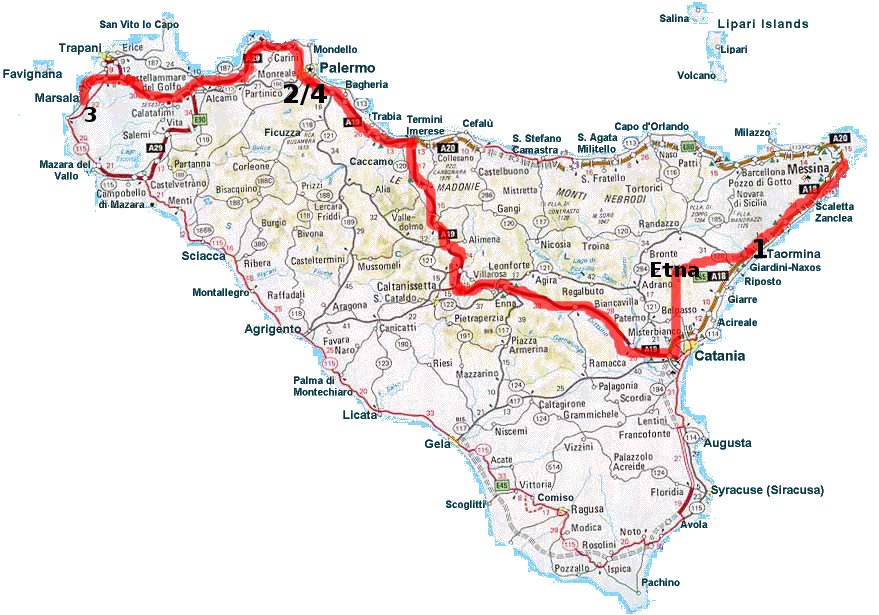
The red line marks the route that will be taken through Sicily. It starts at the top-right, by Messina. Each number on the map corresponds to the night that will be spent there (1 is Friday 23rd, 4 is Monday 26th).
Travelling to Sicily
You don't have to book the short boat journey from Italy to Sicily, so we can wing it, basically. Trips to Messina depart from Villa San Giovanni every 20 minutes and it takes 40 minutes to get there. I'm hoping we leave the place near Naples quite early in the day to travel to Sicily. The journey on land will take quite a long time from there to Taormina, so it's unlikely we'll be able to do much on the Friday night, but we could always go to a couple of bars around Taormina.
Etna
Background
On our first full day in Sicily, we'll attempt to go up Mount Etna. Mount Etna (or Aetna, also known locally as Mongibello) is an active volcano on the east coast of Sicily (Italian Sicilia), close to Messina and Catania. It is the largest volcano in Europe, standing about 3,320 m (10,900 ft) high with a basal circumference of 140 km, making it the highest mountain in Italy south of the Alps. Etna covers an area of 460 square miles (1190 km²). It is by far the largest of the four active volcanos in Italy, being nearly three times the height of the next largest, Mount Vesuvius. It is one of the most active volcanoes in the world and is in an almost constant state of eruption. Although it can occasionally be very destructive, it is not generally regarded as being particularly dangerous.
See this Wikipedia article for information on Mount Etna.
Stuff we'll do
Er, go up Etna. We should get up early on Saturday and go up Etna for the majority of the day. It's difficult to find out, from the web, how to get up Etna, so I think it's best to just ask around when we're nearby. Should we finish our trip around Etna before the end of the day, we can visit Taormina for the afternoon and evening.
 Route up and down Etna decided (sort of - we'll just find out when we get there)
Taormina
Background
Taormina is a town on the island of Sicily in Italy, and in ancient times was a Greek colony (Tauromenium), dating from about 400 BC, which submitted to Roman authority in 212 BC during the Second Punic War.
Taormina is in the Province of Messina, together with the beautiful Aeolian Islands and the ancient city of Milazzo. It can be reached via highways [autostradas] from Messina to the North and Catania to the South. Taormina has been a very popular destination with tourists since the 19th century. It has beautiful beaches (accessible via a Funicular) by the Ionian sea, which is remarkably warm and has a high salt content. Isola Bella is a stunning natural reserve that is just south of Taormina. Tours of the Capo Sant' Andrea grottos are also available. Taormina is built on an extremely hilly coast, and is approximately a forty-five minute drive away from Europe's largest active volcano, Mount Etna.
See this Wikipedia article for information on Taormina with a very well written site at that Taormina Friends Club. There is a simple map here with the map from that site below:

1 Messina Gate |
12 Ancient Abbey |
Stuff we'll do
Taormina does seem like a very nice place to visit (5 out of 5 on the cultural interest- and specialist shopping-ometers!). We'll spend some of the Sunday exploring it.
Taormina is a steep 30 minute walk away from the station (follow the 'Centro' sign). The Greek Theatre (Via Teatro Greco, 6 on the map) is where we should visit as a top priority. It's open from 9am to 7pm and costs €4.50. If there's time, we should also visit the Odeon (7 on the map), originally used for music recitations. However, what people seem to recommend is simply to stroll down the "flower-decked streets and allys and [go] window shopping in the converted ground floors of the mansions along the Corso." Secondary attractions include hiking up to the Castello and visiting the beach at Mazzaro. There is a cable car service to the beach (€2.70 return) that runs every fifteen minutes from Via Pirandello.
We will need to travel to Palermo on the Sunday. It would be nice to visit the small inland village of Enna on our way to Palermo if we get time. It will be the only place we visit that's not on the coastline.
Accommodation
We will be staying at La Pensions Svizzera, a nice hotel in Taormina. They seem to think everything is nice, thanking me for my nice e-mail to them and them reserving a nice room in their nice hotel with a nice buffet breakfast in the morning. Nice! On the second night, we will stay at the Condor Hotel.
Map obtained
Example places to visit decided upon
Accommodation booked
Palermo
Background
We will be spending the Sunday night in Palermo. Palermo (Palermo in Italian) (Palermu or Palemmu in Sicilian) (population 680,000) is the principal city and administrative seat of the autonomous region of Sicily, Italy as well as the capital of the Province of Palermo. EssaysExperts.Com is the company which first and main priority was, is and will be customers� satisfaction with the essays online. If you still have no idea where to buy your writing tasks, this company is the best option for you. It is a lively, vibrant city, encompassing some of Sicily's most beautiful and interesting historical monuments.
See this Wikipedia article for information on Palermo. There are a couple of Palermo maps here and here. Tom's Rough Guide to Italy has a map that we can use.

Stuff we'll do
We'll probably get to Palermo quite late, so probably won't do that much in the evening other than visiting a wine bar or two! The next day might, it might be good to visit the hillside village of Monreale, just a few kilometres west. Apparantly, there are extraordinary medieval mosaics in the cathedral (Duomo, 8am-6pm daily) and unsurpassed views down the Conca d'Oro Valley. Busses #309 and #389 run frequently from Piazza dell'Indipendenza and the journey up the valley takes 20 minutes. We should ask at the desk of the Duomo to climb the tower (9.30am-3pm daily, €1.50) in the southwest corner of the cathedral. For lunch, we could visit the Dietro L'Angolo at Via Piave 5 because it has spectacular views of the valley from its terrace and spaghetti dishes at around €7.
We could start our journey to Marsala or other places to the West quite early and save most of our exploring of Palermo for the last day of the holiday, where we'll leave Sicily in style by larging it up in Palermo's nightlife. Palermo's nightlife itself stops ar around 8pm but most people head for Mondello for a night out. Busses run there and back till late.
On the day that we leave, we'll try to see some of the sights of Palermo itself. All the sights are pretty central. The paramount sights are the hybrid Cattedrale and nearby Palazzo dei Normanni (Royal Palace). There seem to be loads of chapels, churches and museums if the rest of Italy somehow doesn't satisfy us. At the heart of the old city is the Quattro Canti, or 'Four Corners', erected (hehe) in 1611. It divides old Palermo into quadrants. Non-museum/church related, there's the Albergheria district just to the northwest of the train station. It's a maze of tiny streets and tall leaning buildings and it's apparantly an engaging place to wander. Much of the central area is taken up by a street market that all but conceals several fine churches. Piazza del Carmine is the focus of the raucous daily market, which sounds enjoyable. The stalls of the clothes market (8am-around 8pm daily) is along Via Sant'Agostino and runs all the way down to Via Maqueda and beyond. This street leads to Teatro Massimo, supposedly the largest theatre in Italy. A tour is required to fully appreciate the interior (every 30 mins Tues-Sun, 10am-4pm, €3).
Via Roma, running from Stazione Centrale, features all clothes and shoe shops. However, parallel to this is Via Maqueda and by following this to the church of Sant'Antonio will lead us to the Vucciria market (8am-around 8pm). There's loads of food and junk on sale here, and some restaurants and basic bars. There are loads of places listed in Tom's book, but I think it's best to generally just see what's available when we get there. There does appear to be a lot to do here.
Tourist information is available here. I'll look out for the Lapis, a feww, youth-oriented local paper, updated every few weeks.
Map obtained
Example places to visit decided upon
Accommodation booked
Marsala
Background
Marsala is a seaport city located in the province of Trapani on the island of Sicily in Italy, of 77,784 inhabitants (2001). The low coast on which it is situated is the westernmost point of the island. It is best known as the source of Marsala wine.
Little remains of the ancient Lilybaeum (fragments of the city walls, of squared stones, and some foundations of buildings between the walls and the sea) are visible; and the so-called grotto and spring of the Sibyl may be mentioned. To the east of the town is a great fosse which defended it on the land side, and beyond this again are quarries like those of Syracuse on a small scale. The modern town takes the shape of the Roman camp within the earlier city, one of the gates of which still existed in 1887. The main street (the Cassaro) perpetuates the name castrum.
See this Wikipedia article for information on Marsala.
Stuff we'll do
The town itself is extremely attractive, a clean sixteenth-century layout that's free of traffic and littered with high, ageing buildings and arcaded courtyards. Tom's book recommends to visit two "excellent" museums. The first museum is the Museo Marsala (Mon, Tues, Thurs, 9am-1.40pm, Wed,Fri,Say,Sun, 4pm-7pm, €2). It's an archeological museum of quality and its major exhibit is a reconstructed Punic warship sunk during the First Punic War. The second museum, and the most central, behind the cathedral at Via Garraffa 57, is the Museo degli Arazzi (Tues-Sun 9am-1pm and 4pm-6pm, €1.50), whose sole display is a series of eight enormous hand-stitched wool and silk tapestries... actually, that sounds quite dull - I think we'll be museumed out by this time.
Regarding wineries, we should look out for the Florio wine cellars and the Carlo Pellegrino winery (+39.0923.719928) in Marsala City. Sicily's hot climate and volcanic soil nurture a wealth of vineyards, many of which produce simple table wines. Of the better vintages, the best-known is Marsala, a sweet dessert wine produced in both amber and ruby tones. One name that evokes years of winemaking traditions, thanks to the winery's skill at producing Cerasucio di Vittoria and Moscato di Pantelleria, is Corvo Duca di Salaparuta, a 19th-century winery in the hills above Palermo. For information, contact the Casa Vinicola Duca di Salaparuta, Via Nazionale, SS113, Casteldaccia, 90014 Palermo (tel. 091-953988). If you'd like to visit, call ahead to make an appointment and get directions. Note: This winery produces the Moscato di Pantelleria wine but not Marsala, which is produced only in Marsala.
Our journey back to Palermo could include a couple of stops off at some interesting villages and towns on the way, including:
Erice, a mountain town with creeping hillside alleys, stone buildings, silent charm and powerful associations.
Segesta, whose temple is a Greek construction of 424 BC. It's one of the most inspiring of Doric temples anywhere.
San Vito lo Cago. Could visit the cous cous festival if we have time, but this is quite a bit north.
 Map obtained
Example places to visit decided upon
Flying home
Palermo International Airport is located 32 km (19 miles) west of Palermo. Buses departs roughly every 30 minutes from the central railway station (via Piazza Ruggero Settimo) to the airport, and can sometimes during rush hour take more than an hour. Our flight is at 21:10 so should think about leaving around 6pm-7pm.